
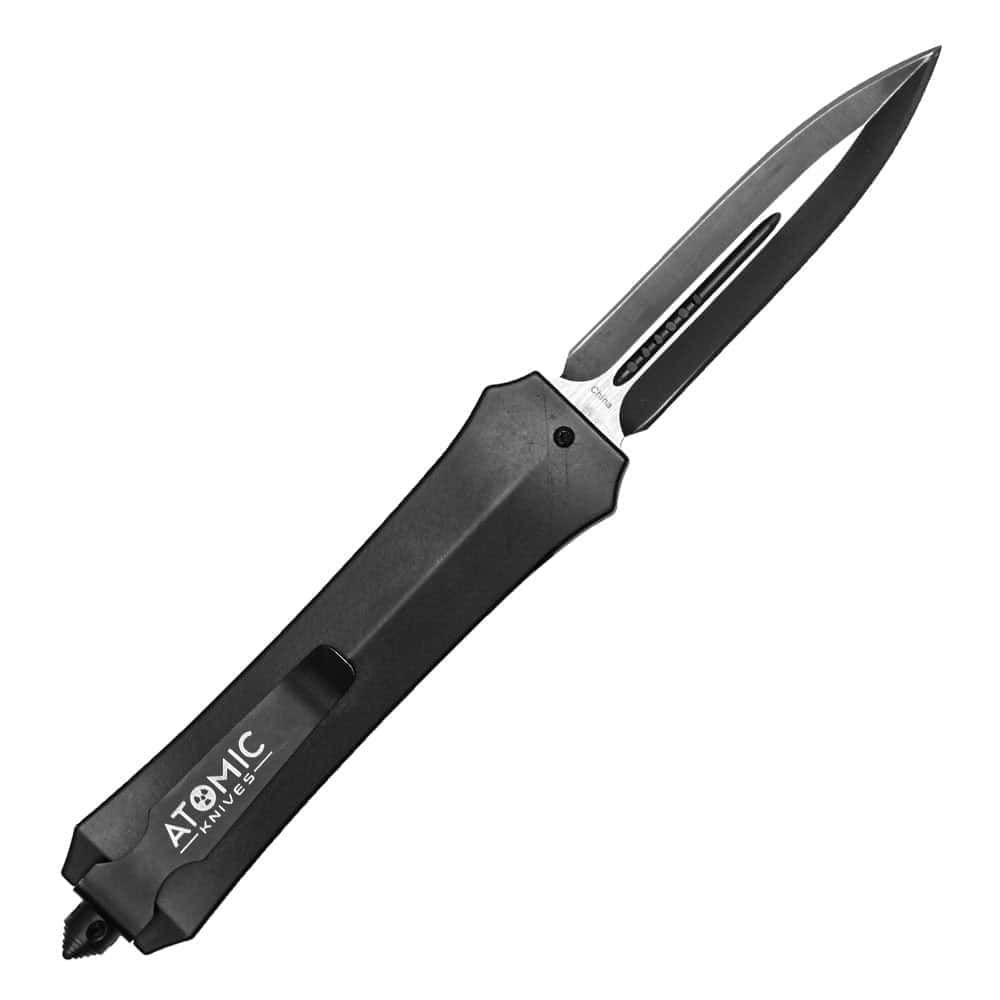
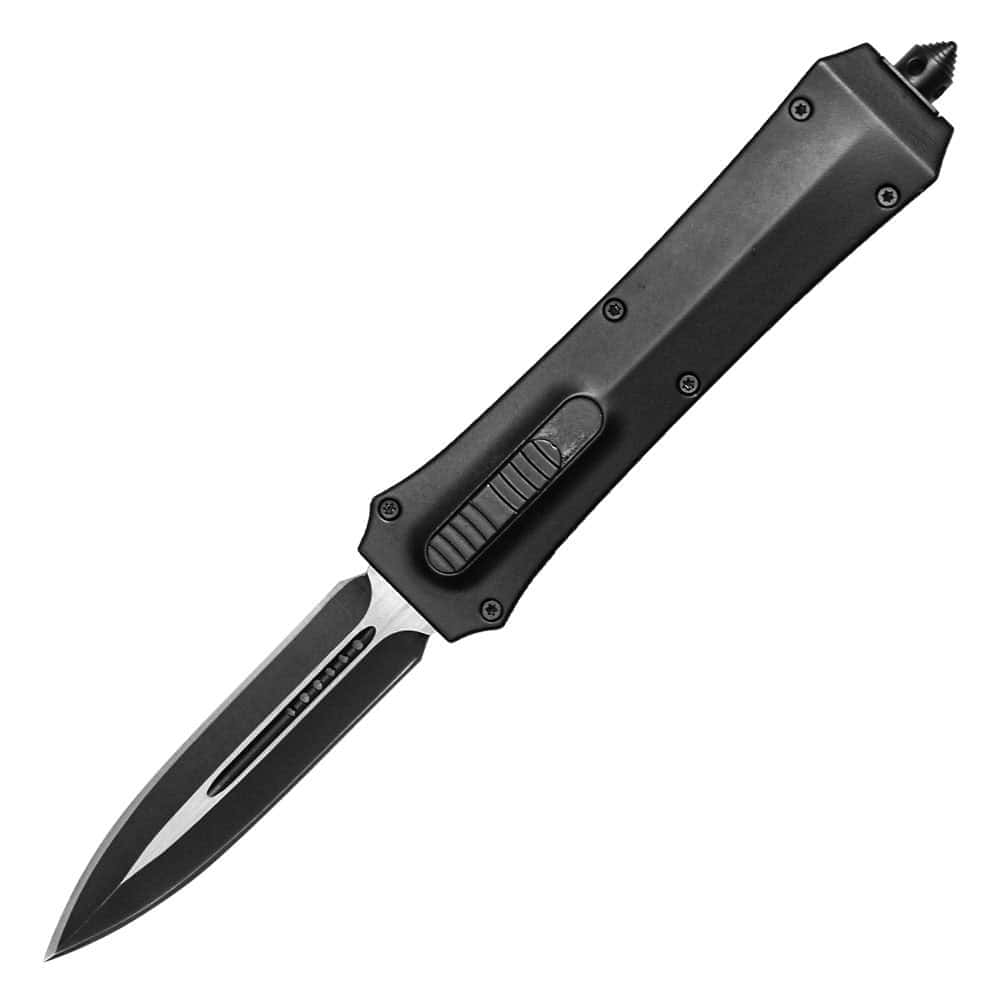
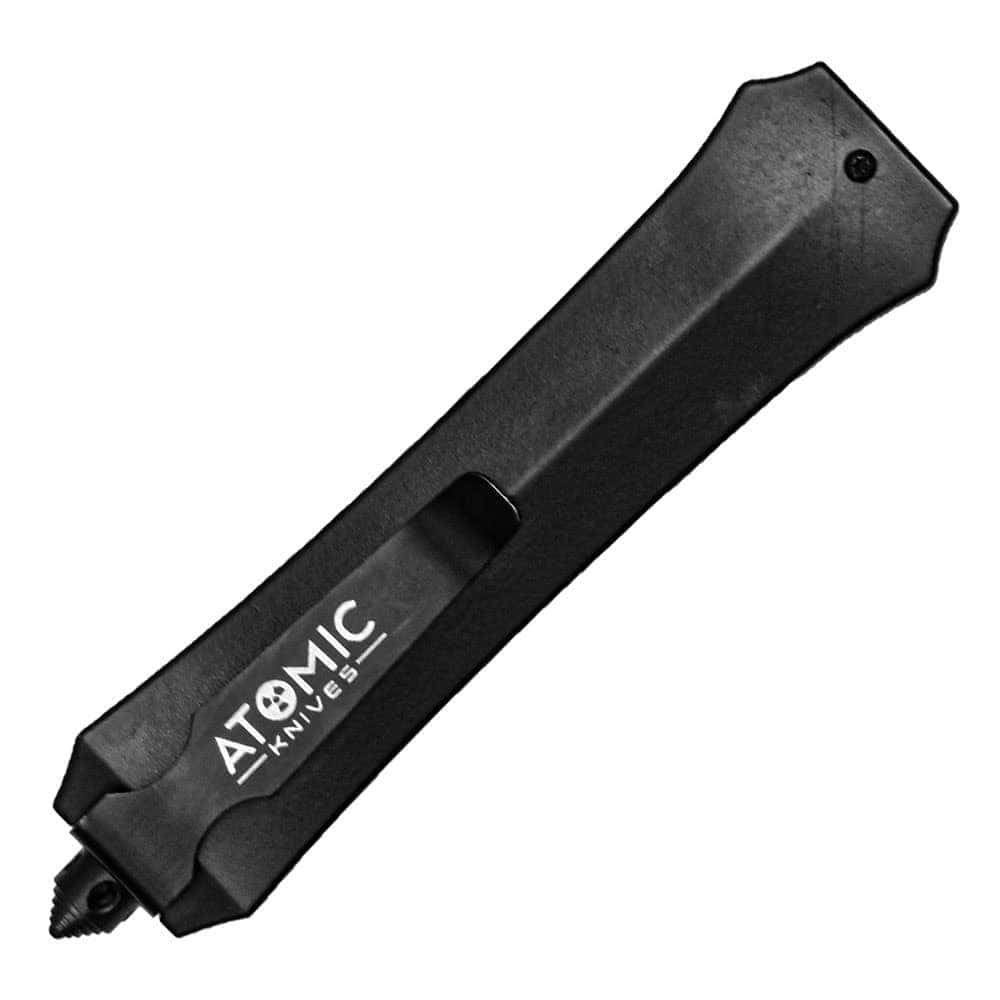
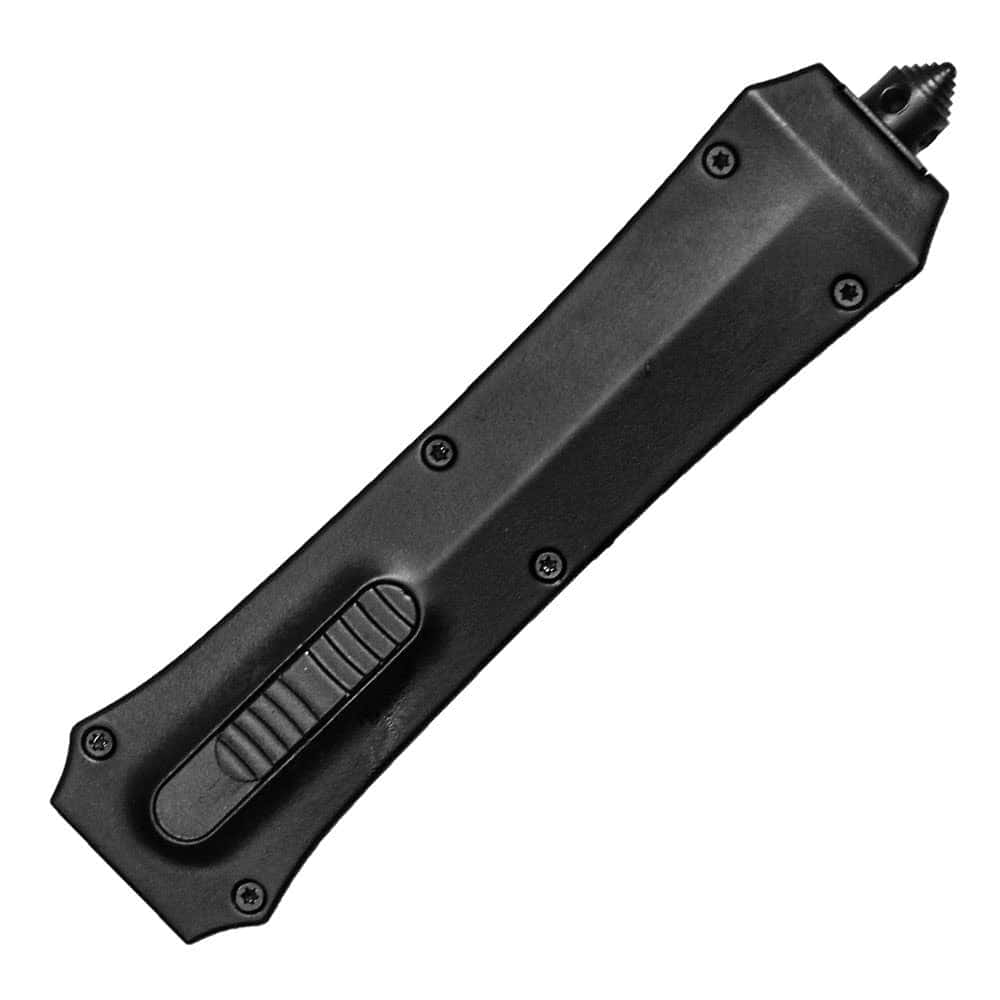
OTF Automatic Heavy Duty Knife – Double Edge Blade, Out-The-Front Deployment, 3.75-Inch Blade, 9.5-Inch Overall, Black Steel
Original price was: $119.85.$101.87Current price is: $101.87.
Buy with Confidence
Covered by a 30-Day Money Back Guarantee. If it's not right for you, returns are easy and hassle-free.

Secure checkout • 100% Satisfaction Guaranteed • 30 Day Money Back Guarantee • Easy Returns • Fast Customer Support
This is the real deal — an OTF automatic where the blade fires straight out the front of the handle with one push. Double-edged blade, 3.75 inches of steel, retracts just as fast as it deploys. If you've never used an OTF before, the action alone is worth the price. This isn't a toy, though — it's a serious knife built for people who know what they want.
- Out-the-front (OTF) automatic deployment — blade fires from the handle tip
- Double-edge 3.75-inch blade for versatile cutting capability
- One-push deploy and retract — fast in both directions
- 9.5 inches overall, 5.75 inches collapsed for pocket carry
- Heavy-duty steel construction at 0.7 lbs — built to last
Front-Deploying, Double-Edged, Built Heavy
Most automatic knives deploy the blade from the side — the blade swings out like a folding knife, just faster. An OTF is different. The blade fires straight out the front of the handle. Push the switch forward, blade’s out. Pull it back, blade retracts. It’s a completely different mechanism that keeps the blade aligned with the handle at all times. This one adds a double-edge blade, which gives you cutting ability on both sides.
Who This Knife Is For
This is not a beginner’s knife, and the price reflects that. You’re someone who specifically wants an OTF mechanism because you understand the advantages — true one-handed operation, no wrist flick, blade stays inline with the handle. You might be a first responder who needs fast blade access with one hand. You might be a collector who appreciates well-built automatics. You might just want the best knife on this page. Fair enough.
Is This the Right Choice for You?
Choose the OTF Double Edge if you want:
- True out-the-front deployment with one-push operation
- A double-edge blade for maximum cutting versatility
- Heavy-duty construction that feels substantial in the hand
Consider something else if you need:
- A single-edge blade for more controlled, everyday cutting tasks
- A more affordable automatic (the side-deploy models are less than half the price)
Why Double Edge?
A double-edge blade cuts on both sides, which means you can slice in either direction without repositioning the knife. That’s useful for certain cutting tasks and gives you more versatility than a single-edge blade. The trade-off is that double-edge blades are a bit harder to sharpen and require more attention during use since both edges are live. If you’re comfortable with that, the double edge is the more capable option.
The OTF mechanism itself is impressively smooth. The blade fires out with authority and locks into place with a solid click. Retraction is just as fast — pull the switch back and the blade disappears into the handle. The whole knife weighs 0.7 lbs, which gives it a substantial feel. This isn’t a lightweight folder — it’s a heavy-duty tool that’s built to handle serious use.
Quick Comparison: How Does a Self-Defense Knife Stack Up?
| Feature | Self-Defense Knife | Pepper Spray | Stun Gun | Personal Alarm |
|---|---|---|---|---|
| Everyday Utility | Cutting tool + defense ✓ | Defense only | Defense + flashlight | Defense only |
| Range | Arm’s reach | 8-12 feet ✓ | Contact only | Audible range |
| No Batteries/Refills | Always ready ✓ | Expires | Needs charging | Needs batteries |
| Legal Carry | Varies by state/blade length | Most states ✓ | Most states ✓ | Legal everywhere ✓ |
| Best For | Utility + last-resort defense | Distance defense | Close encounters | Drawing attention |
Practical Details
Blade length is 3.75 inches. Collapsed, the knife is 5.75 inches. Overall length when deployed is 9.5 inches. Black steel construction throughout. At 0.7 lbs, it’s heavier than the side-deploy models, which is typical for OTF mechanisms — the internal spring assembly takes up more space and weight. Automatic knife laws vary significantly by location, so check your local regulations before purchasing.
If you know you want an OTF, you know why — stop shopping and grab this one.
Frequently Asked Questions
What’s the advantage of OTF over a regular automatic?
The blade stays inline with the handle, which means you can deploy and retract with one hand without changing your grip. Regular automatics swing the blade out from the side, which requires a slightly different hand position. OTF is faster and more ergonomic for repeated use.
Is the double edge practical for everyday use?
It depends on what you’re doing. For general utility cutting, a single edge is usually more practical and safer. The double edge shines when you need to cut in both directions or want maximum blade versatility. If you’re not sure, the single-edge OTF model might be the better everyday choice.
Why does this cost more than the side-deploy automatics?
OTF mechanisms are more complex to manufacture. The internal spring assembly, the sliding track, and the locking mechanism all require tighter tolerances than a standard side-deploy automatic. You’re paying for a more sophisticated mechanism, not just a bigger knife.
| Type of Knife | Automatic |
|---|---|
| Overall Length | 9.5 inches |
| Blade Length | 3.75 inches |
| Collapsed Length | 5.75 inches |
| Weight | 0.7 lbs |
| Dimensions | 9.5" x 1.38" |
Additional information
Related products
-
Sale!

Comb Metal Knife – Disguised 3.5-Inch Half-Serrated Blade Hidden in Functional Comb, 6.5-Inch Overall, Black or Pink
Original price was: $9.99.$8.49Current price is: $8.49. Select options This product has multiple variants. The options may be chosen on the product page -
Sale!

Assisted Open Folding Pocket Knife with Accent Handle – 3.25-Inch 3Cr13 Steel Blade, Belt Clip, Lanyard Hole, 4 Two-Tone Color Combos
Original price was: $36.60.$31.11Current price is: $31.11. Select options This product has multiple variants. The options may be chosen on the product page -
Sale!

Automatic Heavy Duty Knife with 5-Hole Handle – 3.5-Inch Blade, Stainless Steel, Safety Lock, Black, 8-Inch Overall
Original price was: $37.80.$32.13Current price is: $32.13. Read more -
Sale!

Multi-Function Survival Business Card – 11-in-1 Wallet Tool, Stainless Steel, Leatherette Pouch, Credit Card Size
Original price was: $4.99.$4.24Current price is: $4.24. Add to cart
Reviews
There are no reviews yet.