
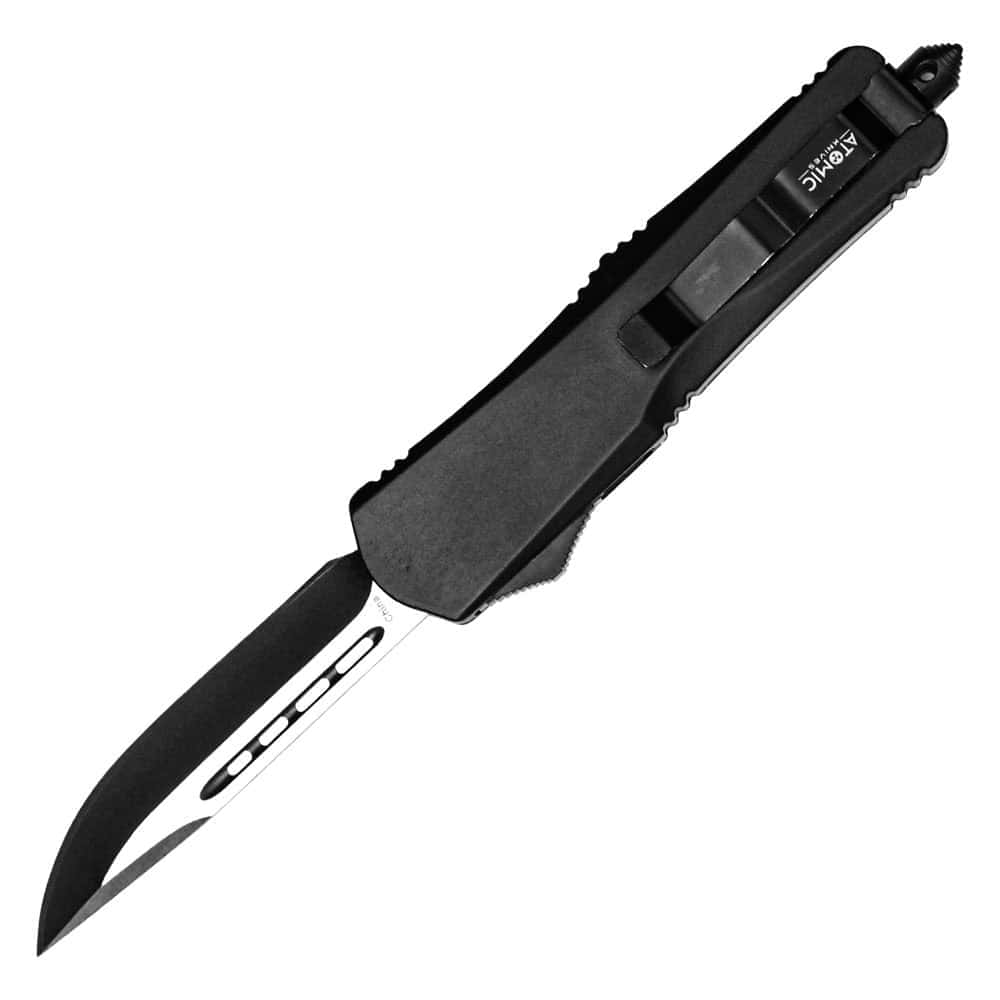
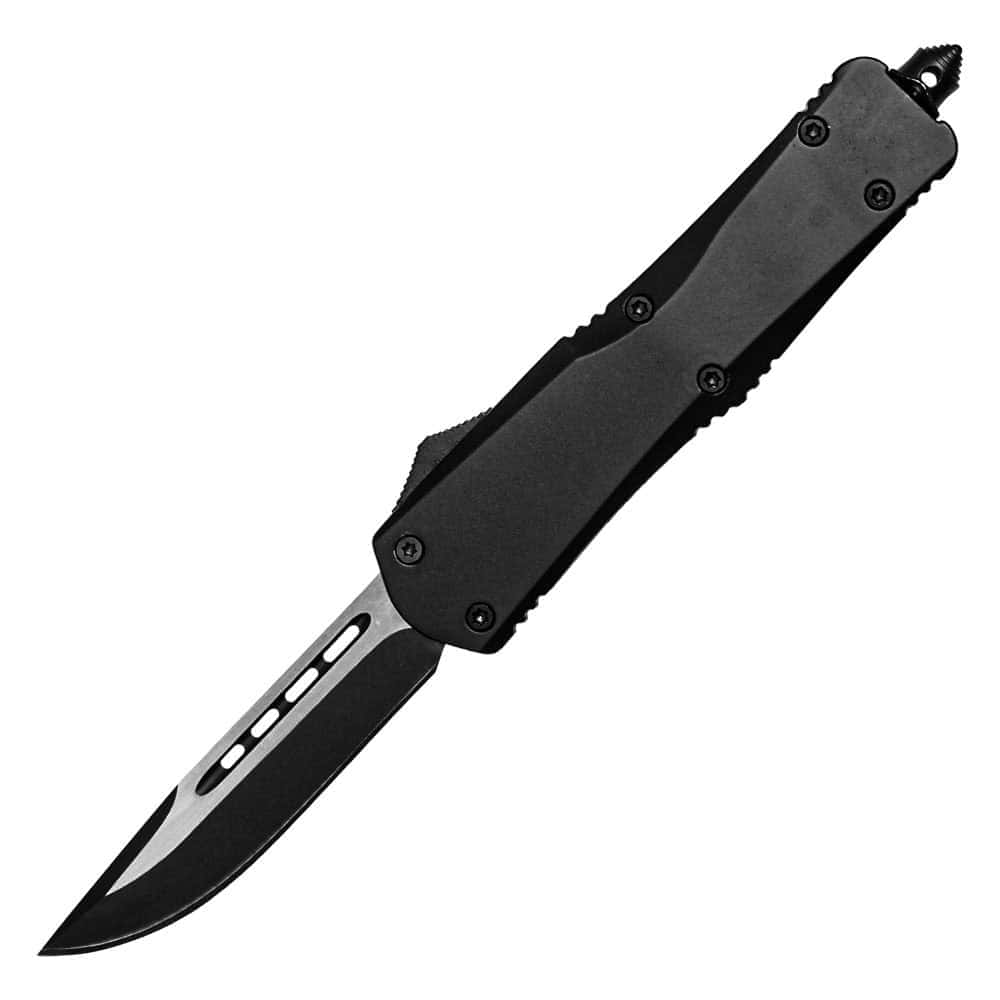
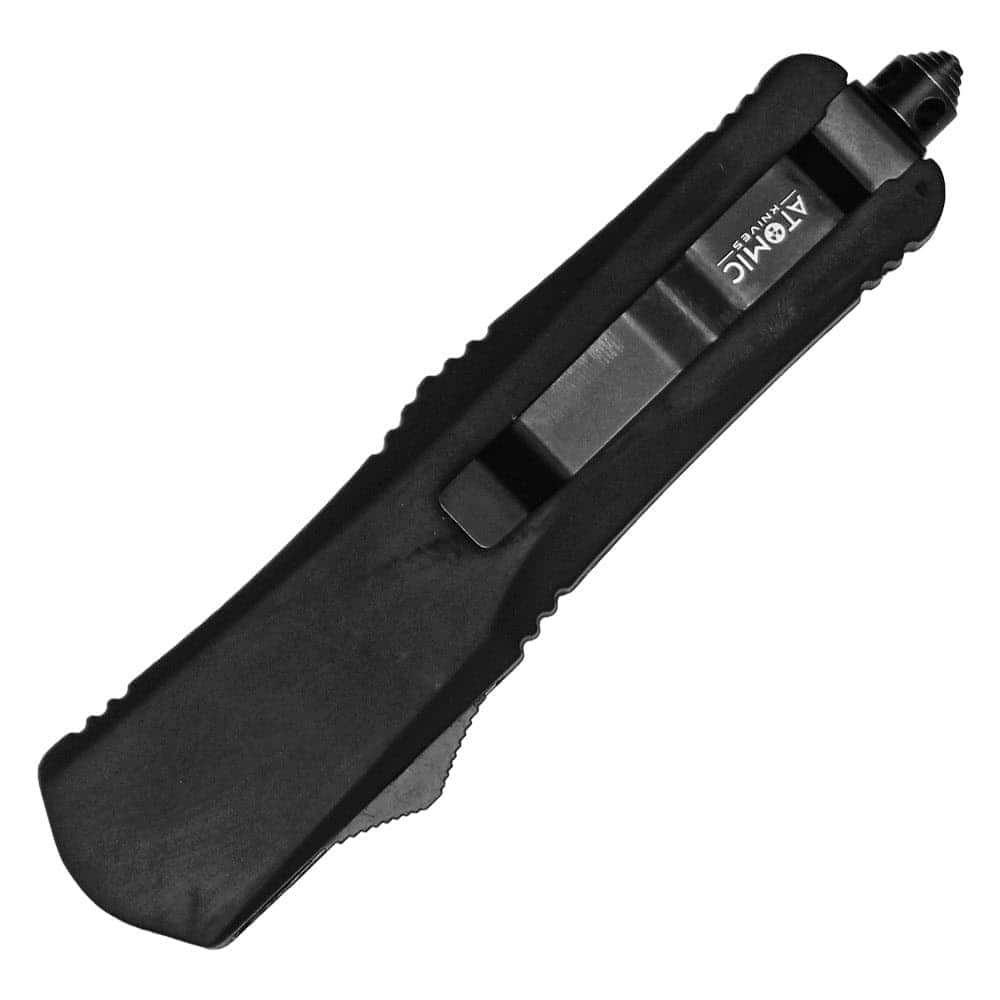
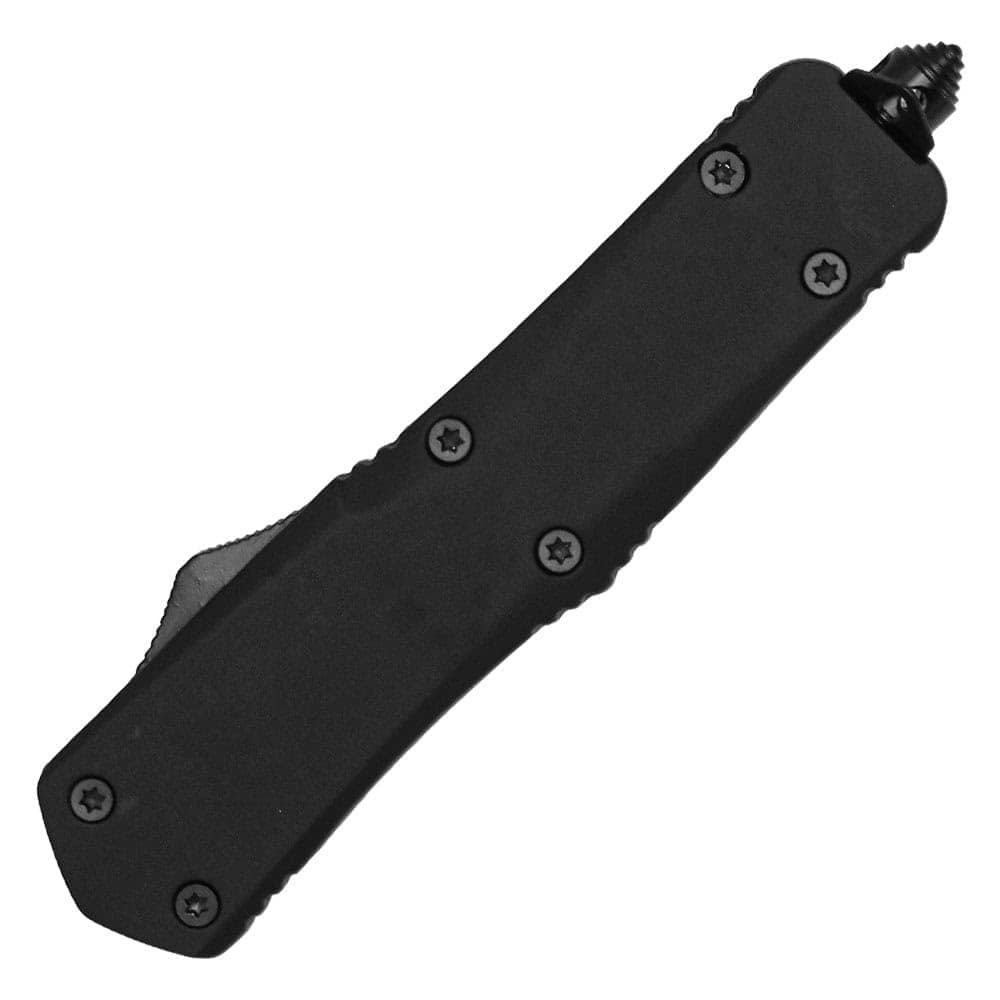
OTF Automatic Heavy Duty Knife – Single Edge Blade, Out-The-Front Deployment, 3.5-Inch Blade, 9-Inch Overall, Black Steel
Original price was: $119.85.$101.87Current price is: $101.87.
Buy with Confidence
Covered by a 30-Day Money Back Guarantee. If it's not right for you, returns are easy and hassle-free.

Secure checkout • 100% Satisfaction Guaranteed • 30 Day Money Back Guarantee • Easy Returns • Fast Customer Support
Same OTF mechanism as the double edge — blade fires straight out the front, retracts with one pull — but with a single-edge blade. That makes it more practical for everyday cutting tasks where you want a clear cutting edge and a flat spine. 3.5-inch blade, 9 inches overall, heavy-duty steel construction. All the OTF benefits, more everyday versatility.
- Out-the-front (OTF) automatic — blade deploys and retracts from the handle tip
- Single-edge 3.5-inch blade for practical, controlled cutting
- One-push deploy and retract for true one-handed operation
- 9 inches overall, 5.5 inches collapsed — pocket-carry friendly
- Heavy-duty steel at 0.7 lbs — same build quality as the double edge
The More Practical OTF
If you want the OTF experience but plan to actually use this as an everyday tool, the single-edge version is probably the smarter choice. You get the same front-deploying mechanism, the same heavy-duty construction, the same satisfying action — but with a blade that has a proper cutting edge on one side and a flat spine on the other. That means you can press your thumb on the spine for controlled cuts, which you can’t safely do with a double edge.
Who This Knife Is For
This is for the person who wants an OTF for practical reasons, not just because it looks cool. You work with your hands and need fast blade access. You want to open packages, cut rope, break down materials — tasks where a single edge gives you more control. You’re also someone willing to invest in a quality mechanism because you’ve been through enough cheap knives to know the difference. The OTF mechanism is a genuine upgrade in one-handed usability.
Is This the Right Choice for You?
Choose the OTF Single Edge if you want:
- An OTF mechanism with a more practical, everyday-use blade
- The ability to thumb-press the spine for controlled cuts
- Heavy-duty build quality in a slightly more compact package
Consider something else if you need:
- Double-edge versatility (check the OTF Double Edge model)
- A budget automatic knife (the side-deploy models are under $25)
Single Edge for Real-World Work
A single-edge blade is the standard for a reason. You have a sharp cutting edge where you need it and a flat spine where you don’t. That means you can apply thumb pressure on the spine for precision cuts. You can use the spine to scrape without cutting. You can handle the knife more confidently in tight spaces where a second edge would be a liability. For daily utility work, single edge is the practical choice.
The OTF mechanism works the same as the double-edge version. Push the switch forward, blade fires out and locks. Pull it back, blade retracts. Completely one-handed, no grip change required. The action is smooth and the lockup is solid. At 0.7 lbs, the knife has real presence in your hand — it’s built heavy on purpose.
Quick Comparison: How Does a Self-Defense Knife Stack Up?
| Feature | Self-Defense Knife | Pepper Spray | Stun Gun | Personal Alarm |
|---|---|---|---|---|
| Everyday Utility | Cutting tool + defense ✓ | Defense only | Defense + flashlight | Defense only |
| Range | Arm’s reach | 8-12 feet ✓ | Contact only | Audible range |
| No Batteries/Refills | Always ready ✓ | Expires | Needs charging | Needs batteries |
| Legal Carry | Varies by state/blade length | Most states ✓ | Most states ✓ | Legal everywhere ✓ |
| Best For | Utility + last-resort defense | Distance defense | Close encounters | Drawing attention |
Practical Details
Blade length is 3.5 inches — slightly shorter than the double-edge model’s 3.75 inches. Collapsed length is 5.5 inches. Overall open length is 9 inches. Black steel construction. Same 0.7 lb weight. The shorter blade and slightly shorter overall length make this a touch more pocket-friendly. Check your local knife laws before purchasing — automatic and OTF regulations vary widely.
OTF speed with everyday practicality — the single edge makes this the working person’s automatic.
Frequently Asked Questions
Should I get the single edge or double edge?
If you’re using it as a daily tool — opening things, cutting materials — go single edge. The flat spine gives you more control and safety. If you want maximum blade versatility or you’re more of a collector, the double edge is the more interesting option.
Is the blade easy to sharpen?
A single-edge blade is straightforward to sharpen with any standard sharpening stone or system. Maintain a consistent angle on the beveled side and you’re good. Much easier than maintaining two edges on the double-edge model.
How does the OTF mechanism hold up over time?
OTF mechanisms are more complex than side-deploy automatics, but they’re built to handle thousands of cycles. Keep it clean, avoid forcing it if it feels gritty, and give the track an occasional drop of light oil. Most issues come from pocket lint getting into the mechanism — a blast of compressed air fixes that.
| Type of Knife | Automatic |
|---|---|
| Overall Length | 9 inches |
| Blade Length | 3.5 inches |
| Collapsed Length | 5.5 inches |
| Weight | 0.7 lbs |
| Dimensions | 9" x 1.25" |
Additional information
Related products
-
Sale!
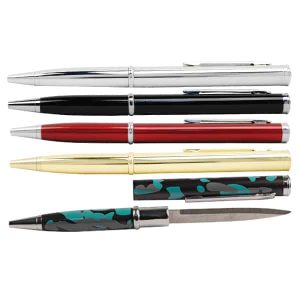
Pen Knife – Disguised 2.13-Inch Blade Hidden in Working Pen, Pen Cap Safety, Ink Cartridge Included, 5 Colors
Original price was: $9.99.$8.49Current price is: $8.49. Select options This product has multiple variants. The options may be chosen on the product page -
Sale!

Multi-Function Survival Business Card – 11-in-1 Wallet Tool, Stainless Steel, Leatherette Pouch, Credit Card Size
Original price was: $4.99.$4.24Current price is: $4.24. Add to cart -
Sale!

2-Piece Throwing Knife Set – Black & Gold BioHazard Design, 9-Inch 440 Stainless Steel, Nylon Sheath Included
Original price was: $17.40.$14.79Current price is: $14.79. Add to cart -
Sale!

Automatic Heavy Duty Knife with Solid Handle – 3.5-Inch Blade, Stainless Steel, Safety Lock, Black, 8-Inch Overall
Original price was: $37.80.$32.13Current price is: $32.13. Read more
Reviews
There are no reviews yet.